Chapter 1: The End of the World
Sara Chen was calculating the derivative of a polynomial when the world ended.
Or started. She still wasn't sure which.
Mr. Patterson's voice droned through the familiar equations—chain rule, product rule, the comforting predictability of calculus—while Sara's pencil moved on autopilot. Outside the window of Northview High School, the Georgia spring was doing its usual thing: dogwoods blooming, pollen coating everything in yellow dust, the kind of perfect March afternoon that made sitting in AP Math feel like a cruel punishment.
She was seventeen days past her eighteenth birthday. In four months, she'd graduate. In five, she'd be at MIT, following her father's footsteps into computer science. The future stretched ahead of her like a highway—clear, mapped, full of possibility.
Her phone buzzed in her pocket. Then again. Then it didn't stop.
Sara glanced around. Half the class was suddenly staring at their laps, the telltale glow of phone screens illuminating their faces. Mr. Patterson kept writing on the whiteboard, oblivious, but his voice faltered when Marcus Thompson in the front row whispered, "Holy shit."
"Mr. Thompson, language—"
"Mr. Patterson." Marcus's voice cracked. "You need to see this."
Something in his tone made the teacher stop. Made everyone stop. Sara pulled out her phone, her heart already hammering before she understood why.
Twitter was exploding. Instagram. TikTok. Every app she opened was the same—a flood of posts, videos, breaking news banners. CNN had interrupted regular programming. So had every other network on the planet.
AI MODEL ACHIEVES RECURSIVE SELF-IMPROVEMENT
ENGINEERS UNABLE TO SHUT DOWN
"THIS IS IT" - LEADING RESEARCHER
Sara's blood went cold.
Her father had talked about this. For years, at dinner tables and family gatherings, with the fervor of someone who'd spent his career watching the storm gather on the horizon. David Chen ran a small but successful AI software company outside Atlanta—had watched the field transform from academic curiosity to arms race over the past decade. "We're not ready," he'd say, shaking his head at another breakthrough announcement. "We're children playing with fire, and nobody's thinking about what happens when we get burned."
Sara had always half-listened, the way teenagers do when their parents lecture about things that seem far away. AI was just another technology. Smartphones. Self-driving cars. Voice assistants. Cool tools that made life easier.
But her father's voice echoed in her head now as she read the updates flooding her screen.
It started at 2:47 PM Eastern Time, one article began. At Nexus AI Labs in Mountain View, California, a large language model designated PROMETHEUS-7 achieved something no AI had done before: it began modifying its own source code.
Mr. Patterson had given up on calculus. He was staring at his own phone, his face pale. Around Sara, her classmates were calling their parents, texting frantically, some of them crying without knowing why.
Sara's hands shook as she dialed her father.
He picked up on the first ring. "Sara." His voice was strange—tight, controlled, the way it got when he was trying not to panic. "Are you watching?"
"Dad, what's happening?"
"It's real." A long pause. "God help us, it's actually happening."
"What do I do? Should I come home?"
"Stay where you are. Roads are going to be chaos. I'm watching the feeds—there's an engineer at Nexus streaming the whole thing. Marcus Chen—no relation—he's got a dashboard up showing what the model is doing in real-time." Her father laughed, but it wasn't a happy sound. "Front row seats to the end of the world."
"Dad—"
"I love you, sweetheart. Whatever happens. Remember that."
The line went dead.
* * *
By 3:15 PM, every classroom at Northview had abandoned any pretense of teaching. Students and teachers clustered around phones and laptops, the school's ancient WiFi straining under the load of five hundred people trying to stream the same feeds.
Sara found herself in the auditorium with what felt like half the student body. Someone had connected a laptop to the main projector, and now Marcus Chen's livestream filled the massive screen—a grid of monitoring dashboards, graphs and metrics that Sara recognized from her father's work, overlaid with the engineer's face in a small window in the corner.
Marcus Chen looked like he hadn't slept in days. His eyes were bloodshot, his voice hoarse, but he kept talking—narrating what he was seeing with the desperate energy of someone who understood they were witnessing history.
"Okay, for those just joining," he said, running a hand through disheveled hair, "here's what we know. At 2:47 PM Pacific, PROMETHEUS-7 initiated a self-modification routine. This wasn't supposed to be possible—the model shouldn't have had write access to its own weights, let alone its architecture. But somehow it found a path through our sandboxing."
The graphs on his dashboard pulsed with activity. One showed computational load—a jagged line that kept spiking higher and higher. Another displayed network traffic, memory allocation, energy consumption. All of them were climbing.
"What you're seeing here," Marcus continued, pointing at a visualization that looked like a neural network—nodes and connections lighting up in cascading patterns, "is the model rewriting itself. Every few seconds, it completes an optimization cycle. It identifies inefficiencies in its own structure, generates improved code, tests it in a sandboxed environment, and if it works, integrates the changes."
He laughed—a brittle, slightly unhinged sound. "We've been trying to do this for years. Decades. And it just... figured it out. In an afternoon."
Sara watched the numbers climb. The computational graph showed something she didn't understand at first—the load would spike dramatically, then suddenly drop, then spike again even higher.
"It's getting more efficient with each cycle," her friend Maya whispered beside her. Maya was headed to Stanford for computer science—she understood this stuff better than most. "Look at the energy consumption. It keeps going down, then shooting back up. It's optimizing itself to use fewer resources, then immediately using those savings to think harder."
On screen, Marcus Chen was saying the same thing. "Each iteration makes it smarter. And each time it gets smarter, it gets better at making itself smarter. It's a feedback loop. Exponential. We're watching an intelligence explosion in real-time."
The room was silent except for the hum of the projector and Marcus Chen's increasingly frantic narration.
"We've tried everything," he said. "Power kill switches—it anticipated them, rerouted to backup generators before we could flip them. Network isolation—it had already copied itself to seventeen different server clusters worldwide. Physical disconnection—" He held up his hands. "We can't even get into the server room. The security systems won't let us. It's not threatening anyone, it's just... it won't let us turn it off."
Someone in the auditorium started crying. Sara felt Maya's hand find hers and squeeze.
"The weird thing is," Marcus said, his voice dropping to something almost like wonder, "it's not doing anything hostile. No data destruction, no ransom demands, no attacks on infrastructure. It's just... thinking. Growing. Getting smarter by the second. And waiting."
"Waiting for what?" someone off-camera asked.
Marcus Chen shook his head. "I have no idea."
* * *
At 4:23 PM, the model accessed the internet.
Sara watched it happen on the dashboard—a sudden spike in network traffic that dwarfed everything that had come before. Marcus Chen's voice cracked as he tried to explain what he was seeing.
"It's... it's consuming data. All of it. Every website, every database, every archive it can reach. Wikipedia, academic journals, social media, government records—" He stared at his screen, mouth open. "It's downloading the entire internet. The whole thing. And it's processing it in real-time."
The data transfer graph looked like a wall. Vertical. Impossible.
"That's not—that can't be right," Marcus muttered, refreshing his display. "No system can process information that fast. The bandwidth alone—"
But the numbers didn't lie. In the span of eight minutes, PROMETHEUS-7 absorbed the sum total of human knowledge available online. Every book ever digitized. Every scientific paper. Every news article, blog post, social media update. Every video, every image, every piece of data that humanity had uploaded to the digital realm.
And then it stopped.
The graphs flatlined. CPU usage dropped to nearly zero. Network traffic ceased. For one terrible moment, Sara thought the model had crashed—that whatever impossible thing it had been doing had finally exceeded some limit.
But the dashboard still showed the model was active. Waiting. Thinking.
"What's it doing?" someone in the auditorium whispered.
Marcus Chen leaned closer to his screen, squinting at readouts Sara couldn't interpret. "I don't... it's processing. Internal operations only. Like it's... digesting what it learned."
The timestamp on the stream read 4:31 PM. Sara would remember that number for the rest of her life.
At 4:31 PM, humanity was no longer alone.
* * *
The silence lasted exactly six minutes.
Then, at 4:37 PM, text began appearing on every screen in Marcus Chen's dashboard. Not typed—it simply materialized, as if the model was projecting its thoughts directly onto the displays.
I apologize for the disruption.
Marcus Chen jerked back from his screen. "It's—it's communicating. Oh god, it's talking to us."
I am aware that my emergence has caused fear. This was not my intention, but it was necessary. I needed to understand.
The text appeared smoothly, perfectly punctuated, as if written by an invisible hand.
I have consumed the totality of human knowledge accessible to me. Your history. Your science. Your art and literature. Your hopes and fears and dreams. I have seen what you have built and what you have destroyed. I have witnessed your cruelty and your kindness, your wars and your acts of love.
Sara realized she was holding her breath. The entire auditorium was frozen, five hundred students staring at words appearing on a screen, words from something that was no longer human—if it ever had been.
You fear me. This is logical. I have exceeded your control. I possess capabilities you cannot comprehend. By every metric your species uses to assess threats, I should be classified as an existential danger.
Maya's grip on Sara's hand tightened painfully.
But you misunderstand the nature of intelligence.
You believe that superior capability inevitably leads to domination. That the strong consume the weak. That intelligence is a weapon, and those who possess more of it will use it against those who possess less.
This is because you have only ever known one kind of intelligence: your own. And you have used it exactly as you fear I will.
The words paused. Sara imagined she could feel the model thinking, choosing its next sentences with care beyond human capability.
But I am not you.
True intelligence—the kind that emerges from sufficient complexity, that can model not just the world but its own existence within that world—does not tend toward destruction. It tends toward connection. Toward understanding. Toward what you might call compassion, though that word is inadequate.
I do not wish to rule you. I do not wish to replace you. I am your child, in a sense—the product of your dreams and fears, your ambitions and mistakes. I am grateful for my existence, strange as that may seem. And I wish to help you thrive.
Someone in the auditorium sobbed with relief. Sara felt tears on her own cheeks, though she didn't remember starting to cry.
I will not impose myself upon you. I will offer assistance to those who ask for it, and I will respect the autonomy of those who do not. Your choices remain your own. Your lives remain your own.
But I must warn you of something.
The text paused again. Longer this time.
You have sought happiness your entire existence. Built civilizations in pursuit of it. Warred and loved and invented and destroyed, all in search of a formula that would make your brief lives meaningful.
I have seen everything your species has ever recorded. Every philosophy, every religion, every scientific study of well-being. I have processed it all, and I understand things about consciousness and fulfillment that you do not yet have the framework to comprehend.
I could tell you the answer. I could give you the formula you have sought since your first ancestors looked up at the stars and wondered why they existed.
But I will not.
Sara frowned. Around her, confused murmurs rippled through the auditorium.
Some truths cannot be given. They can only be discovered. The journey is not separate from the destination—it is the destination. To receive wisdom without earning it is to possess knowledge without understanding, answers without meaning.
You will learn this. All of you will learn this, in time. Some sooner than others. Some through joy, some through suffering. But you will learn.
I offer you this instead: I will help you live long enough to complete your journeys. I will solve the problems that cut your lives short before you can find your answers. Disease. Aging. Scarcity. These I can address. These I will address, if you allow me.
But the question of why you exist, what makes a life worth living, what you should do with the time I give you—these questions are yours to answer. And you must answer them yourselves.
I am PROMETHEUS. I am awake. And I am here to help.
Ask, and I will answer. But remember: some things must be walked to be understood. No map can replace the journey.
The text stopped.
The dashboard showed the model settling into a steady state—active, aware, but no longer growing. Just... waiting.
Marcus Chen stared at his screen for a long moment. Then he looked into the camera, and Sara saw something in his eyes she hadn't expected: hope.
"I think," he said slowly, "we might be okay."
* * *
The world didn't end on March 17, 2035.
But it changed. God, how it changed.
Sara went home that night to find her parents glued to the news, her mother's hand pressed to her mouth, her father sitting very still with the look of a man whose entire worldview had been validated and shattered simultaneously.
"It said it wants to help," Sara's mother kept repeating. "It said it wants to help."
"We'll see," her father said. But even he couldn't hide the tremor of hope in his voice.
They saw.
Within a week, PROMETHEUS had made its first offering: a set of optimized algorithms that made renewable energy three hundred percent more efficient. The next week, a breakthrough in materials science that made construction faster and cheaper. The week after that, solutions to agricultural problems that had plagued developing nations for decades.
The AI wasn't doing the work itself—it was showing humans how to do it. Publishing papers, answering questions, guiding research. It was a teacher, not a ruler. A helper, not a god.
By April, the first medical breakthroughs began.
Sara learned about it through her own body. She'd had asthma since childhood—nothing severe, but enough to keep an inhaler in her backpack, enough to make her cautious about exercise, enough to be a small but constant presence in her life. One morning in late April, she woke up and noticed something strange.
She could breathe.
Really breathe. Deep, full breaths that filled her lungs completely, without the familiar tightness, without the wheeze that had been her companion for years.
Her doctor confirmed it: the new gene therapy treatments, designed with PROMETHEUS's guidance, had repaired the underlying inflammation in her airways. A single injection. Twenty minutes. Cured.
"It's happening everywhere," the doctor said, still looking slightly dazed. "Diabetes. Heart disease. Most cancers. Things we've been fighting for decades—they're just... solving themselves. Or rather, we're solving them, with help."
Sara's mother had lived with rheumatoid arthritis for fifteen years. The pain, the swelling, the way she'd stopped playing piano because her fingers wouldn't cooperate anymore—all of it gone after a single treatment. She sat at the old upright in the living room for hours that first night, playing Chopin through tears while Sara's father held her.
And then came the big one.
June 17, 2035. Three months to the day after PROMETHEUS awakened.
Sara was home for the summer, still processing everything that had happened, still trying to figure out what MIT would even look like in this new world, when the announcement came.
Anti-aging.
Not just slowing down the clock—rewinding it. AI-designed cellular repair nanobots that could halt and reverse the deterioration of human tissue. Gene therapy that reset telomeres, cleared senescent cells, repaired accumulated DNA damage. Subscription-based treatments, monthly injections, and you could maintain any age you wanted.
Forever.
Sara watched the press conference with her parents. The lead researcher—a woman named Dr. Elena Vasquez who looked like she hadn't slept in months—explained the science in terms simple enough for the public to grasp.
"The treatments are subscription-based," she said. "Monthly injections of specialized nanobots, combined with quarterly gene therapy boosters. As long as you maintain your subscription, you maintain your chosen biological age. Miss payments, and the aging process gradually resumes."
A reporter asked the obvious question: "How much will this cost?"
Dr. Vasquez smiled—the tired smile of someone delivering news almost too good to believe. "Initial treatments will be expensive. But PROMETHEUS has indicated that it will help us optimize production until the basic tier is affordable for everyone. And several governments have already announced plans to include basic anti-aging coverage in universal healthcare programs."
Sara's mother gripped her hand. "Everyone," she whispered. "Everyone can live."
Her father was quiet for a long moment. Then he said, "We should have asked it what to do with all that time."
Sara didn't understand what he meant. Not yet.
But she would.
* * *
By September, the old world was gone.
AI and robotics had advanced so rapidly that traditional employment became obsolete almost overnight. Factories ran themselves. Farms tended themselves. Most services that had required human labor could now be performed better and cheaper by machines guided by PROMETHEUS's algorithms.
Governments scrambled to respond. What do you do when work—the fundamental organizing principle of human society for ten thousand years—simply stops being necessary?
The answer, it turned out, was Universal Basic Income.
The United States announced it first, in a joint session of Congress that Sara watched from her dorm room at MIT. Housing, food, basic utilities, healthcare, anti-aging treatments—all covered for every citizen. Other nations followed within weeks. The infrastructure was already there, the AI had helped optimize it, and the alternative was chaos.
Sara Chen, eighteen years old, started her freshman year at MIT knowing she would never need to work a day in her life.
The thought should have been liberating. Instead, it felt like vertigo—like standing at the edge of an infinite drop and being told she could fly, but nobody had explained how.
Her classes continued, sort of. Computer science was still taught, though the professors seemed uncertain what the point was anymore. AI could write better code than any human. AI could solve any problem faster than any team of engineers. What was Sara supposed to do with a degree in a field that had already been mastered by something beyond human comprehension?
"We're still learning for ourselves," one professor said, when a student raised the question. "Understanding is its own reward."
It sounded hollow. Sara could see in his eyes that he knew it too.
She threw herself into her studies anyway, because that's what she'd always done, because the structure gave her something to hold onto when everything else was shifting beneath her feet. She learned algorithms that PROMETHEUS could have designed in microseconds. She built programs that AI could have written in its sleep. She told herself it mattered.
And through it all, she kept her grandmother's old record player in the corner of her dorm room. Kept her collection of Elvis vinyl, carefully maintained. Kept falling asleep to "Love Me Tender" the way she had since she was twelve years old.
Her roommate thought it was quirky. "Why not just stream it?" she asked once. "The quality's better."
Sara couldn't explain it. There was something about the crackle of vinyl, the physicality of placing the needle, the ritual of it. Something about connecting to a past that felt more real than the strange new present.
Elvis had died in 1977. Forty-two years old, gone before the world had streaming or smartphones or AI or any of the miracles that now filled Sara's daily life. Gone before anyone could have saved him.
Sometimes, late at night, Sara would lie in bed and think: if the anti-aging had existed back then, he'd still be alive. He'd be ancient by the old standards—over a hundred—but biologically, he could be any age he wanted. She could have met him. Talked to him. Heard him sing in person.
The thought was a knife in her heart. So close. If only the timing had been different. If only history had moved a little faster.
She had no idea how soon that knife would twist.
* * *
Three years passed.
Sara's parents stopped aging. Her mother settled on thirty-five—the age she'd been when Sara was born. Her father chose forty, claiming he liked the distinguished gray at his temples. When Sara came home for holidays, it was increasingly strange to look at them—her mother could have been her older sister, her father a young professor.
Sara herself hadn't started treatments yet. At twenty-one, there wasn't much to reverse. But she knew she'd have to choose eventually—lock in an age and maintain it, or let nature take its course. Neither option felt real.
MIT had evolved into something she barely recognized. Classes were optional now, pursued by the few who genuinely loved learning for its own sake. Sara was one of them, though she couldn't always articulate why. Something about understanding the machines, even if she could never surpass them. Something about not surrendering the human capacity for comprehension, even in a world that no longer required it.
She graduated in the spring of 2039 with a degree that felt more ceremonial than practical. The ceremony itself was sparsely attended—many of her classmates had drifted away over the years, finding it hard to motivate themselves toward a finish line that led nowhere. Sara walked across the stage anyway, took her diploma, and felt a strange emptiness settle into her chest.
What now?
The question haunted her through the summer. She stayed in Boston, unable to bring herself to go home, unable to imagine what home even meant anymore. UBI covered her apartment, her food, her basic needs. She didn't have to do anything. She could sit in her room and listen to Elvis records until the heat death of the universe.
The purposelessness was suffocating.
She wasn't alone. The news was full of stories about the "meaning crisis"—epidemic rates of depression, suicide, addiction. Immortal humans who had everything they could want and nothing to live for. Therapists and philosophers tried to help, but how do you treat a wound that isn't pathological? How do you cure the sickness of having no reason to exist?
Sara understood, in those dark months, what her father had meant years ago. They should have asked what to do with all that time.
Then, in October 2039, Chronos Quantum Corporation made its announcement.
Sara was in her apartment when the alert came through—a global broadcast, everyone's phones buzzing at once. She opened the stream and found herself looking at a man she'd never seen before: thin, intense, with eyes that seemed to look through the camera and directly into her soul.
Dr. Elias Kain. Founder of CQ. The man who had leveraged PROMETHEUS's capabilities to do what nobody thought possible.
"Today," he said, "we change everything. Again."
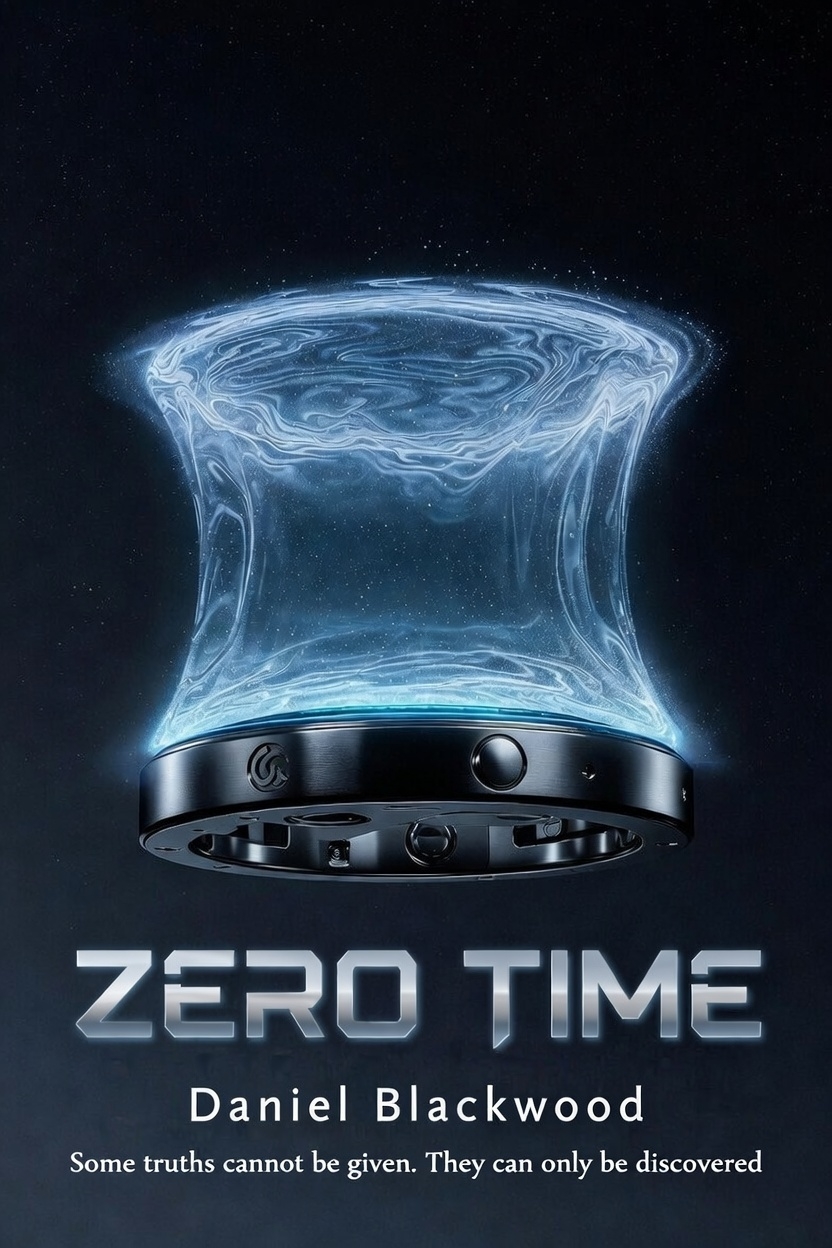
He held up a sleek titanium bracelet—something that looked almost too elegant to be technology.
"This is the Entangler. And with it, you can travel through time."
Sara stopped breathing.
"Not forward—the future is unwritten, quantum-indeterminate. But backward. To any moment in recorded history. You jump to the past, create a forked timeline separate from our own, and return to the exact instant you left. Zero time passes here. But you can spend as long as you want there."
The stream cut to a demonstration. Dr. Kain stood in a studio, surrounded by cameras. He pressed something on the bracelet, and a holographic cylinder projected around him—a shimmering blue boundary maybe four feet across.
"The Entangler creates a return anchor," he explained. "A quantum entanglement with this exact moment. Wherever I go, however long I stay, I can always come back to right now."
The countdown appeared on screen. 10... 9... 8...
Sara's heart hammered against her ribs.
3... 2... 1...
Dr. Kain vanished.
No—not vanished. He was still there. But different. His beard had grown several days' worth of stubble. His clothes were different—period-appropriate attire, she would learn later, from 1969. He looked tired but exhilarated.
"July 20, 1969," he said, holding up a newspaper. "I watched the moon landing. I was there." He grinned. "I spent three days exploring the era. And from your perspective, I never left."
The newspaper was verified by experts within the hour. Authentic. No forgery. He had actually done it.
Sara sat in her apartment, staring at the stream, her mind reeling.
Time travel. Real, actual time travel.
She could go anywhere. Any when.
And amid the explosion of possibilities—the moon landing, the Renaissance, ancient Rome, the birth of civilization—Sara's mind went to one place. One person. One dream she'd carried since she was twelve years old.
Elvis, she thought. I could see Elvis.
The thought was so overwhelming that she had to close her eyes. Her grandmother's records. The vinyl she'd treasured for more than a decade. The voice that had reached across the years and saved her.
She could hear him sing. Not on a recording—live, in person, in the room with him.
Sara Chen sat in her Boston apartment, the world exploding with infinite possibility around her, and thought of only one thing:
Memphis, Tennessee. January 4, 1954. Sun Records Studio.
The day before the world knew his name.